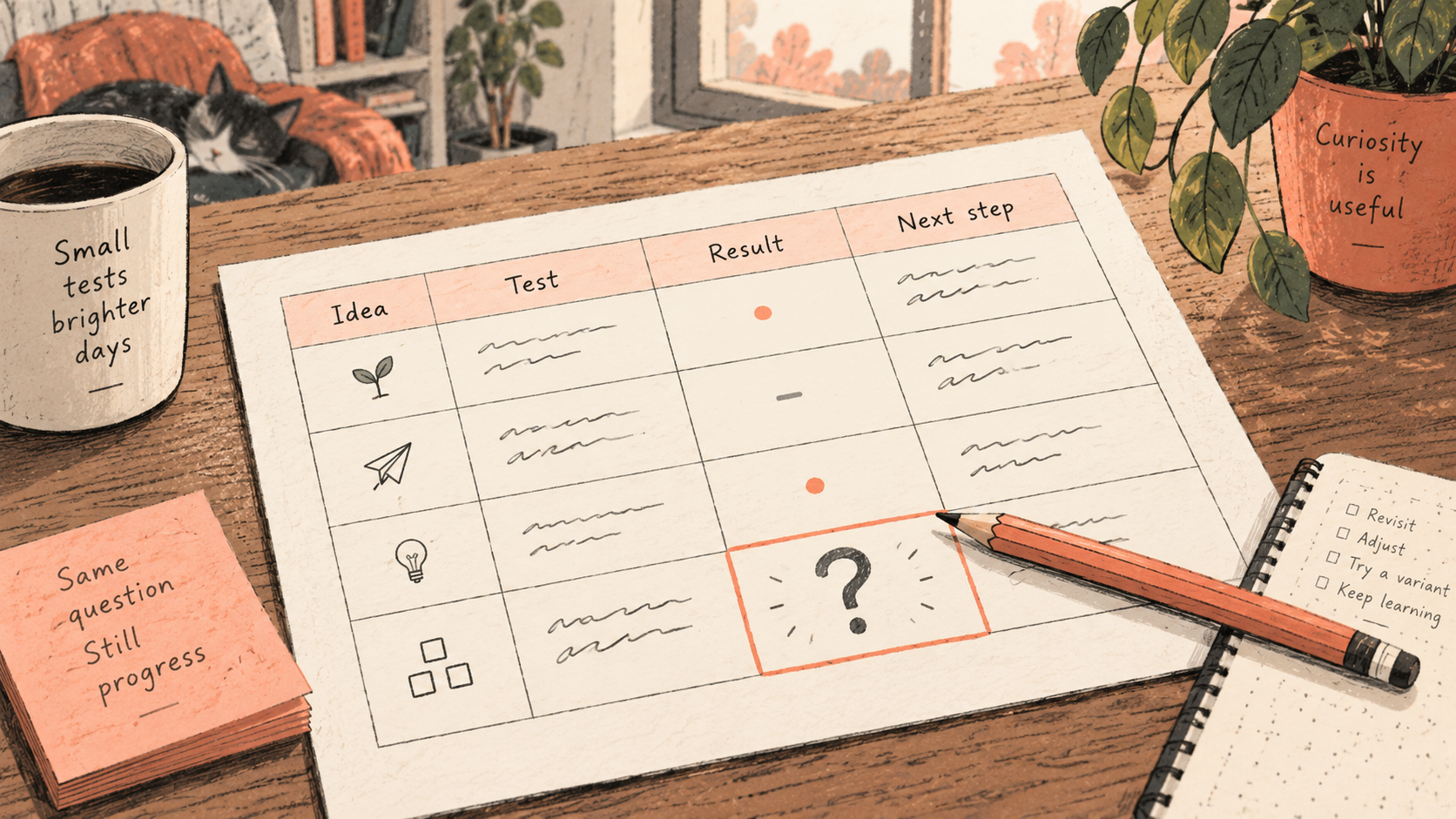
The most useful change to my test register was not a new metric.
It was a place for the result that refused to become a result.
We had changed something with a reasonable question in mind. The observation period produced a small, mixed picture. Nothing clearly supported the confident explanation we had hoped to write.
There is a temptation at that point to find a cheerful detail and promote it to the headline. A particular day looked better. One segment moved. The new version received an encouraging comment.
Those details may deserve investigation. They don't automatically rescue the original test.
I prefer giving “we still don't know” a proper place in the record.
Keep the question intact
A test begins with a claim about what a change might help someone do. The record should retain that question even when the result is awkward.
For a hypothetical page experiment, suppose we changed an explanation because visitors seemed uncertain about the first appointment. We expected the clearer version to help suitable people understand the arrangement and proceed.
If the observed requests are too few to judge, we should say that. If the page changed again halfway through, we should record it. If a business condition moved at the same time, that belongs in the interpretation.
We don't need to describe the experiment as useless. We do need to avoid pretending it answered the original question.
The record can preserve useful observations separately. A recurring enquiry question might inform another change even when the comparison remains inconclusive.
Leave a route back to the idea
An inconclusive result deserves a next decision. Continue observing, revise the experiment, stop for now or return when the conditions make the question easier to examine.
The choice depends on the importance of the question and the work required. Some experiments are worth another careful attempt. Others can wait while the team addresses a clearer problem.
I don't want uncertainty becoming an excuse to keep every test running forever. That creates a register full of dormant promises and makes maintenance surprisingly annoying.
Name what would prompt the next review. Perhaps enough suitable requests have arrived. Perhaps the service arrangement has settled. Perhaps the measurement issue has been corrected.
That makes the drawer a place for useful work rather than somewhere we hide disappointment.
Explain the decision plainly
In the review, I would say what changed, what we observed, why the evidence was limited and what happens next.
The sentence can be short: the requests were too few to assess the effect; the team will maintain the clearer explanation and revisit the question after a longer observation period.
We should still explain why maintaining the change makes sense. A page can be clearer on its own terms even when the commercial effect is uncertain. That judgement and the experiment result are related, but they aren't identical.
I find this kind of reporting a relief. It gives everyone room to be thoughtful without demanding that each month deliver a tidy lesson.
It also makes later work easier. The next person can see which question remains open and avoid rediscovering the same uncertainty.
A confident conclusion is satisfying. A conclusion we can actually support is more useful.
Sometimes the most professional line in the report is “we don't know yet.”
It is a damn good line to have available before optimism takes over the spreadsheet.

A thought worth keeping?