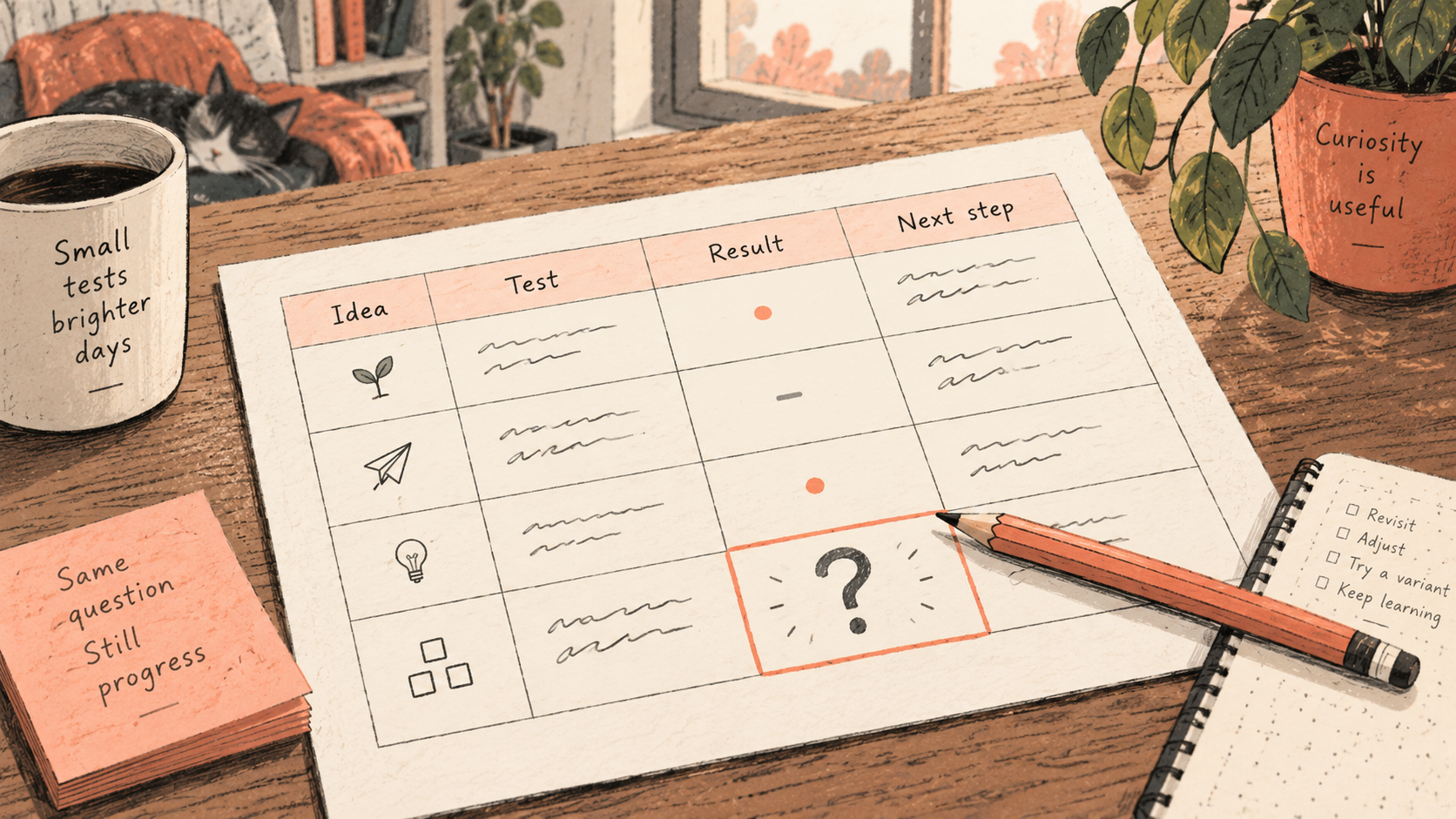
There is a section in my experiment notes for the ideas that didn't produce a tidy answer.
It is not hidden. It is quite well used.
I'm Mark Crossan, a growth marketing manager interested in practical experiments across channels and the business arrangements those experiments depend on. Growth in Practice is where I write about the questions, observations and decisions behind that work.
I like a promising result. I also like knowing which part of the result we can explain and which part remains a guess. The second preference can occasionally make a presentation less exciting. It usually makes the next decision easier.
An experiment starts with a question about a customer action or an experience. The change should have a described reason. The observation needs relevant context. At review, the team should be able to say what happened without rewriting the original question to match the happiest figure.
That is the working discipline I try to keep in this notebook.
A test can stay inconclusive
Some experiments produce too little information. Some encounter a changed offer or an operational interruption. Some simply don't separate the explanations we hoped to examine.
I want those limitations written down along with the useful observations. An inconclusive test can still teach us where to look next.
It also needs a decision. Continue, revise, stop or return later under different conditions. A test register shouldn't become a museum of indefinitely pending conclusions.
I keep the original question, the change, the relevant dates and the next review trigger together. The record can be short. It needs to survive the memory of the people who attended the first discussion.
That helps a later colleague understand why an apparently appealing idea is still waiting for evidence.
The customer sees the combined version
A new advertisement, a clearer page and a changed offer may travel together. Sometimes that is exactly what the experience needs.
The reporting should then describe the combined change rather than casually assigning the improvement to whichever part looked best on a slide.
I enjoy the slightly awkward conversation that follows. What can we reasonably conclude? What would another experiment need to separate? Which improvement is sensible to keep on its own terms?
There is room for judgement without pretending we have isolated every cause.
The packing table belongs in the growth plan
The business still has to fulfil the promise. Stock, response arrangements and the people doing the work can limit the pace in ways an advertising chart doesn't show.
I like involving those colleagues before recommending a larger push. They may know exactly which part can take more demand and which part needs another arrangement first.
A manageable next step should include a review of the customer experience, not merely the arrival of more events in the account.
Sometimes the useful investment is operational. A clearer handover or a better response process can give the next campaign change somewhere reliable to land.
The writing here is candid and conversational, with the occasional mild swearword when enthusiasm has run several steps ahead of the evidence. I write about shop-floor decisions, modest experiments and the temptation to make every month end with a tidy lesson.
I am not immune to that temptation. An attractive graph is persuasive to the person preparing it as well as to everyone else.
The notebook helps me slow down long enough to ask the next useful question.
I want the campaign to make sense, the business to be ready for what it invites and the report to stay honest when the answer is uncertain.
That is a damn worthwhile standard, even on the months when the spreadsheet would prefer something more dramatic.